
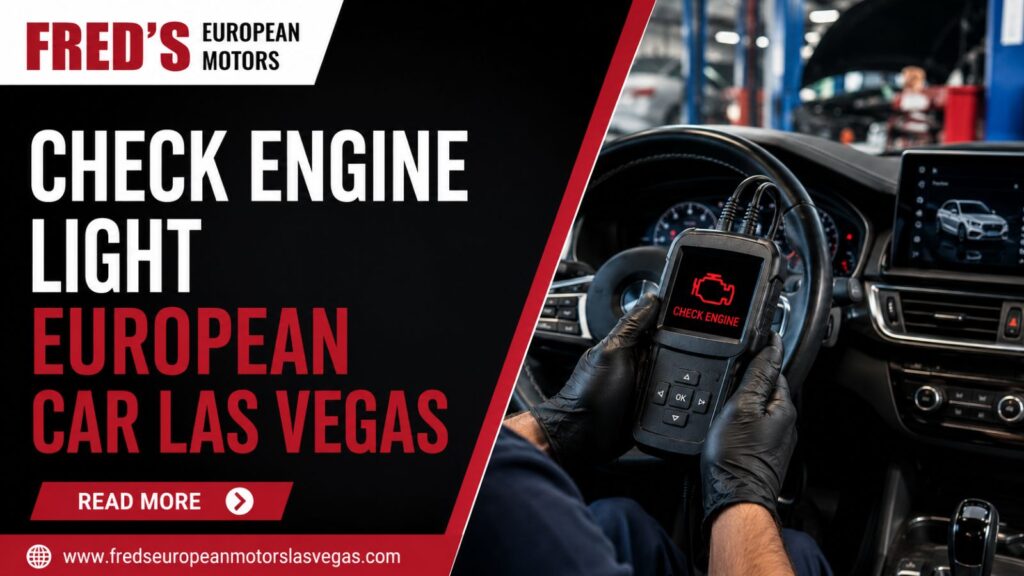
Quick Overview:- A check engine light does not automatically mean your engine is failing, but it should never be ignored. When the light is solid and the vehicle drives normally, avoid hard acceleration, check for obvious issues such as a loose fuel cap, and schedule diagnostics soon. When it flashes or appears with severe shaking, overheating, smoke, stalling, or major power loss, stop driving as soon as it is safe. The warning means the onboard diagnostic system detected a fault; it does not identify the exact failed part. Correct diagnosis requires codes, operating data, symptoms, and testing.
Can You Drive With the Check Engine Light On?
| What you notice | Urgency | What to do |
| Solid light and normal driving | Moderate | Schedule diagnostics soon. |
| Solid light with rough running | High | Limit driving and arrange prompt service. |
| Flashing light | Critical | Reduce speed and stop safely. |
| Severe shaking, power loss, or stalling | Critical | Stop driving and arrange a tow. |
| Rising temperature or red oil-pressure warning | Critical | Shut off the engine immediately. |
| Smoke or a strong fuel odor | Critical | Pull over safely and seek assistance. |
| Light turns off | Attention | The fault may still be stored and should be checked. |
Warning meanings vary by model, so follow the owner’s manual for your European vehicle.
What Does the Check Engine Light Mean?
The check engine light, or malfunction indicator lamp, may turn on because of a misfire, fuel-mixture fault, emissions leak, failing sensor, intake or boost leak, cooling fault, catalytic-converter issue, or unstable voltage. The light confirms that the vehicle detected an abnormal condition. It does not prove that a particular sensor or component has failed.
Solid Versus Flashing Check Engine Light
Solid Check Engine Light
- A solid light usually indicates a stored fault that may not require an immediate roadside stop. If the vehicle feels normal, watch the temperature gauge, avoid aggressive acceleration, check the fuel cap when safe, note any performance changes, and schedule diagnostics.
- Do not clear the code before inspection or ignore the light for weeks. Some faults can damage related components.
Flashing Check Engine Light
- A flashing light is more urgent and commonly indicates an active misfire. Ease off the accelerator, avoid high engine speed, pull over safely, and shut off the engine if it is shaking, overheating, or losing power.
- Continued driving with a severe misfire can overheat the catalytic converter and turn a smaller ignition repair into a much more expensive problem.
What to Do When the Light Comes On
1. Check the Entire Instrument Cluster:- Look for red oil-pressure, overheating, charging-system, brake, or stop-engine warnings. A solid check engine light with normal temperature is different from one combined with overheating or loss of oil pressure.
2. Note How the Vehicle Behaves:- Note rough idle, hesitation, shaking, power loss, hard starting, stalling, smoke, odors, or reduced-power mode, plus when the problem occurs.
3. Check the Fuel Cap:- A loose or damaged fuel cap can cause an evaporative-emissions leak. Park safely, switch off the engine, inspect the cap and seal, and reinstall it securely. The light may remain on until the vehicle completes additional self-tests. Do not assume the cap is the cause simply because it is easy to check.
4. Do Not Clear the Codes:- Erasing codes can remove pending faults, freeze-frame data, and operating conditions. It does not repair the vehicle and may make diagnosis harder.
5. Treat a Code as a Clue, Not a Diagnosis:- A basic scanner can retrieve many engine and emissions codes, but a code does not automatically identify the failed part. A lean-condition code, for example, could come from an intake leak, low fuel pressure, damaged hose, wiring problem, exhaust leak, or incorrect sensor data. Replacing the first component mentioned in an online code description is guesswork. A technician must determine why the code was stored.
Why European Cars May Need More Complete Diagnostics
European vehicles contain interconnected control modules. Manufacturer-capable equipment may access brand-specific codes, live data, misfire counters, turbocharger information, transmission faults, ABS systems, and component tests.
This does not mean every warning requires dealership service. The repair facility simply needs suitable equipment, technical information, and experience for the vehicle.
Common Causes in European Cars
Ignition Misfire:- Spark plugs, ignition coils, injectors, wiring, or mechanical faults can cause rough running, reduced power, or a flashing light. A misfire code does not automatically prove the coil is bad.
Intake, Vacuum, or Boost Leak:- A split hose, loose connection, or leaking seal may cause whistling, rough idle, underboost faults, and reduced power. Testing may be needed to find it.
Oxygen Sensor or Fuel-Mixture Fault:- An oxygen-sensor code may come from the sensor, wiring, an intake or exhaust leak, an injector, or the catalytic converter. Test the system before replacing parts.
Cooling or Electrical Problem:- A thermostat, water pump, cooling fan, coolant leak, weak battery, charging fault, or poor ground can trigger warning lights. Stop driving if the temperature rises above normal, and never open a pressurized coolant reservoir while the engine is hot.
Does Las Vegas Heat Cause the Warning?
Heat alone does not explain every warning, but high temperatures, idling, traffic, and heavy air-conditioning use can expose an existing weakness. Pay close attention when the light appears with rising coolant temperature, rough running after idling, hot-start problems, cooling-fan issues, or stalling after a long drive. The actual fault still needs diagnosis; blaming the weather is not a repair.
What Should Professional Diagnostics Include?
Proper diagnostics should confirm the symptom, scan relevant modules, review codes and live data, test the suspected system, and verify the repair. A scanner is only a tool. Accurate diagnosis depends on testing and correctly interpreting the information.
What if the Light Turns Off?
A light that turns off does not prove that the problem is gone. A pending, history, or permanent code may remain. Intermittent leaks, electrical faults, sensor problems, and temperature-related conditions can cause the warning to appear only during certain trips. Schedule diagnosis if the light returns or the vehicle develops drivability symptoms.
European Car Diagnostics in Las Vegas
Fred’s European Motors provides check engine light diagnostics and European auto repair in Las Vegas for makes including BMW, Mercedes-Benz, Audi, and Jaguar. When booking, provide the vehicle details, warning behavior, recent repair history, and conditions when the fault occurs. This helps reproduce intermittent problems.
Final Takeaway
A check engine light is a request for diagnosis, not an instruction to replace the first part mentioned by a scanner. When the light is solid and the vehicle behaves normally, note the symptoms and schedule service. When it flashes or appears with shaking, overheating, smoke, fuel odors, or major power loss, stop driving and seek professional help.
FAQS
A short drive may be reasonable when the vehicle runs normally, the temperature is stable, and no serious warning is present. Limit unnecessary driving and schedule diagnostics soon.
Avoid continued driving. A flashing light can indicate a severe misfire that may damage the catalytic converter.
Yes. A loose or damaged cap can create an emissions-system leak. Secure it, but arrange diagnosis if the warning remains or returns.
Not always. It may retrieve a code, but additional inspection and testing are often needed to find the actual cause.
No. Clearing codes may remove information that could help locate the fault.

 ICONIER Digital Agency