
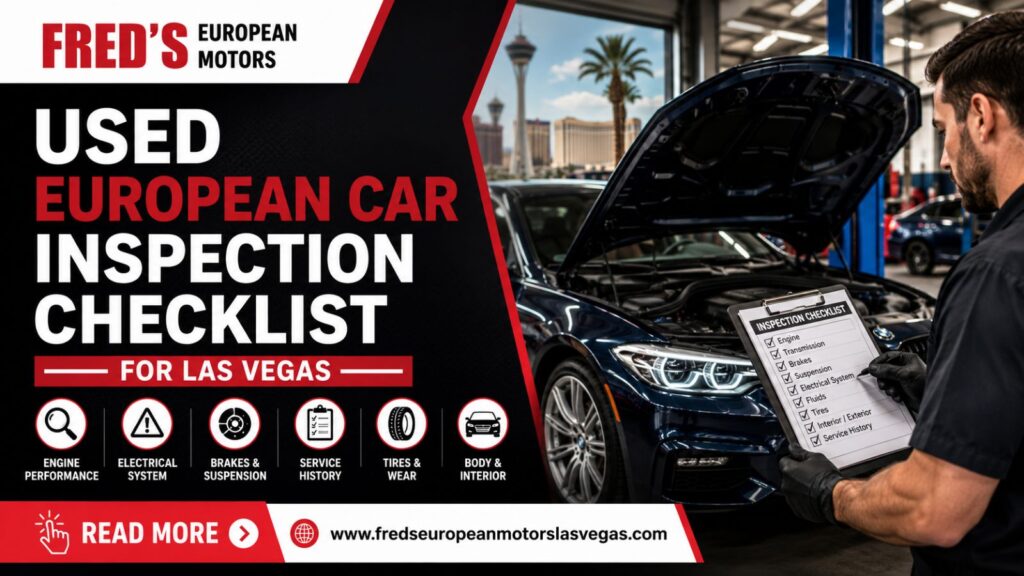
A used European car can deliver luxury and performance for less than its original price. It can also become an expensive mistake when hidden problems are missed. Before signing, arrange an independent inspection, verify the title and VIN, review the history and service records, and check for open recalls.
Quick Used European Car Checklist
| Check | Why it matters |
| Independent inspection | Finds mechanical, electrical, and safety problems |
| Full diagnostic scan | Reveals current, pending, and history faults |
| Service records | Shows whether major maintenance was completed |
| Title and VIN review | Confirms ownership and exposes inconsistencies |
| Vehicle history report | May show title brands, mileage, or total-loss history |
| Recall lookup | Identifies unrepaired safety recalls |
| Cold start and road test | Exposes smoke, noises, shifting, and drivability issues |
| Written repair estimate | Helps you negotiate or walk away |
The FTC recommends an independent mechanical inspection even when a dealer says a used car has been inspected or certified. A history report is useful, but it is not a substitute for inspecting the vehicle itself.
1. Schedule an Independent Pre-Purchase Inspection
- Choose a repair shop that regularly services the exact make, model, engine, and drivetrain you are considering. The inspection should be independent of the seller.
- A proper inspection should include the engine, transmission, cooling system, leaks, brakes, steering, suspension, tires, battery, air conditioning, diagnostic scan, cold start, road test, and a written repair estimate.
- Ask for the VIN, mileage, findings, and repair estimates in writing. The FTC notes that these estimates can help buyers negotiate the sale price. If the seller refuses an independent inspection, choose another car.
2. Verify the Title, VIN, History, and Recalls
- Match the VIN on the dashboard, driver-door label, title, and history report. Any mismatch is a serious warning sign.
- Use an NMVTIS-approved provider to check title information. NMVTIS is designed to help protect buyers from title fraud, stolen vehicles, and unsafe vehicles, but no report contains every accident, repair, or maintenance event.
- Use the VIN to check for unrepaired safety recalls. NHTSA’s lookup can identify certain open recalls for a specific vehicle, although recently announced, very old, or some specialty-manufacturer recalls may not appear.
- For a Nevada private-party purchase, do not buy a vehicle when the seller cannot provide a proper title. Nevada DMV guidance states that liens must be satisfied before sale and that a bill of sale alone is generally not enough to transfer ownership.
Look for:
- Salvage or rebuilt title branding
- Odometer inconsistencies
- Outstanding liens
- Flood or total-loss history
- Missing service records
- Unrepaired recalls
A clean report does not prove the car is problem-free.
3. Inspect the Engine and Cooling System
Check for:
- Oil around the engine, filter housing, turbocharger, or oil pan
- Low coolant or dried coolant residue
- Cracked hoses or aging plastic cooling parts
- Smoke during startup or acceleration
- Rough idle, hesitation, or abnormal noise
- Evidence of overheating
- Warning lights or reduced-power messages
Inspect the car from a true cold start whenever possible. A vehicle that has already been warmed up may not reveal startup smoke, rattles, misfires, or weak-battery symptoms.
Do not assume a small oil or coolant leak will be cheap to repair.
4. Check the Transmission, Suspension, Brakes, and Tires
During the road test, watch for delayed engagement, harsh or slipping shifts, shuddering, drivetrain vibration, or warning messages.
Check the suspension and steering for:
- Clunks over bumps
- Loose or wandering steering
- Uneven ride height
- Excessive bouncing
- Steering-wheel vibration
- Uneven tire wear
Test the brakes for grinding, pulling, pulsation, or a soft pedal. Confirm that the tires are the correct size and type. Uneven wear can indicate alignment or suspension problems.
5. Test Every Electrical Feature
Do not rush this part. Test:
- Air conditioning
- Windows, locks, seats, and mirrors
- Infotainment and navigation
- Cameras and parking sensors
- Driver-assistance systems
- Sunroof or convertible top
- Lights, displays, and all keys
The scan should cover more than the engine computer because faults may be stored in other control modules. Do not accept “it only needs a sensor” without supporting tests.
6. Consider Las Vegas Conditions
Las Vegas heat does not automatically make a European vehicle unreliable, but it can expose weak parts.
Pay close attention to:
- Cooling-fan operation
- Coolant leaks
- Battery condition
- Air-conditioning performance
- Tire age and cracking
- Hoses and seals
- Hot-start problems
- Overheating while idling
Run the air conditioner and confirm that the engine temperature remains stable while idling.
7. Review Service Records and Upcoming Costs
Look for proof of:
- Correct oil and filter changes
- Brake-fluid and cooling-system service
- Spark-plug replacement
- Transmission or driveline service when specified
- Timing-belt service when applicable
- Battery, brake, and tire replacement
- Recall and warranty work
Compare the records with the exact model’s factory schedule.
Ask the inspector to divide findings into:
- Immediate safety repairs
- Repairs needed soon
- Routine maintenance due
- Cosmetic or optional work
Add those costs to the asking price before deciding whether the deal is actually good.
Dealer Paperwork and “As Is” Sales
For dealer sales, read the FTC Buyers Guide. It states whether the vehicle is sold with a warranty or “as is” and reminds buyers to get promises in writing.
Do not rely on statements such as:
- “We will fix that later.”
- “The warranty covers everything.”
- “You can return it within three days.”
- “The warning light is nothing.”
Federal law does not automatically provide a three-day cancellation period. Put every return policy, repair promise, or warranty change in writing.
Red Flags That Mean You Should Walk Away
- Seller refuses an inspection
- VIN or title details do not match
- Warning lights were recently cleared
- Engine is warm before you arrive
- No records for a high-mileage or complex vehicle
- Signs of overheating, flood damage, or major collision repairs
- Transmission slipping or harsh shifting
- Strong fuel, coolant, oil, or burning odors
- Seller pressures you to sign immediately
Walking away is cheaper than buying someone else’s neglected repair project.
Used European Car Inspection in Las Vegas
Before buying a used BMW, Mercedes-Benz, Audi, Volkswagen, Porsche, MINI, Jaguar, Land Rover, Volvo, or another European vehicle, schedule an inspection with a shop familiar with that model. Bring the VIN, listing, history report, and service records. Request written findings and repair estimates before negotiating or signing.
Final Takeaway
A used European car can be a smart purchase only when its condition, history, title, and upcoming costs support the asking price. Never sign based on appearance, a clean history report, or verbal promises. Get an independent inspection, verify the VIN and title, check recalls, review records, and calculate the real cost of making the vehicle reliable.
FAQS
No. It may reveal title, mileage, accident, or total-loss information, but it may miss mechanical faults and unreported repairs.
Yes. Certification standards and warranty coverage vary. An independent inspection can still identify wear, damage, or upcoming maintenance.
Do not buy the vehicle. Refusal removes your best chance to identify hidden problems before the sale.
Yes. Use documented repair and maintenance costs to negotiate. Walk away when the total cost no longer makes sense.

 ICONIER Digital Agency