
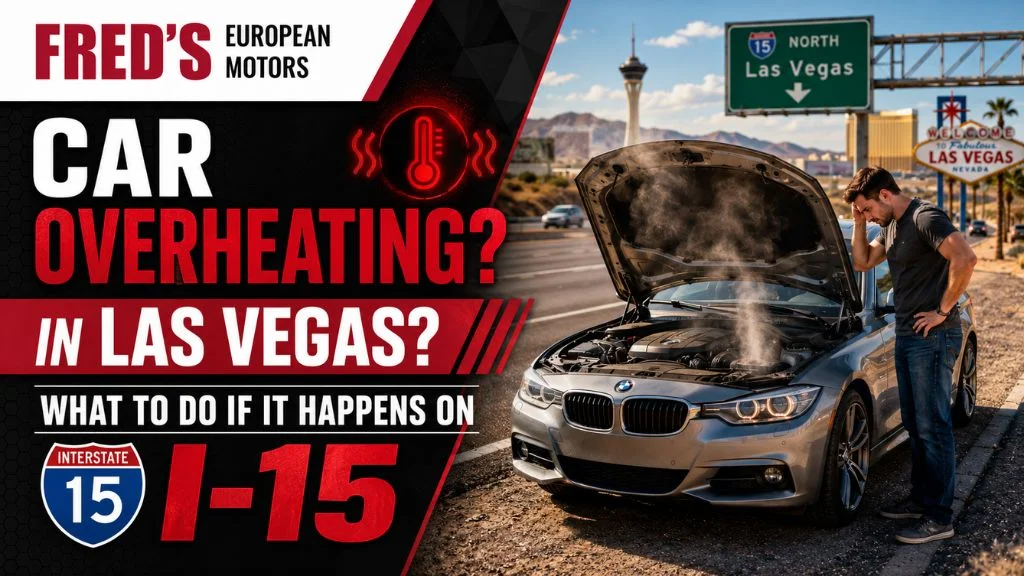
Seeing your temperature warning light come on while driving down I-15 can turn a normal Las Vegas trip into a stressful situation fast. If steam starts coming from under the hood or the temperature gauge moves into the red zone, the most important thing is not making it to your destination. It is getting yourself and your vehicle somewhere safe.
If you are dealing with car overheating in Las Vegas, pull over as soon as you can do so safely and turn the engine off. Continuing to drive an overheating vehicle can make the underlying cooling-system problem worse and potentially cause major engine damage. AAA recommends pulling over safely and shutting the engine down when overheating symptoms appear.
Never immediately remove the radiator cap or coolant reservoir cap from a hot engine. The cooling system may still be pressurized, and hot coolant or steam can cause serious burns.
Here is what to do next and what may be causing your European car to overheat.
What Should You Do Immediately If Your Car Overheats on I-15?
If the temperature gauge suddenly climbs, a warning appears on the dashboard, or you notice steam, follow these steps.
1. Turn Off the Air Conditioning
Switch off the AC as soon as you notice the engine temperature rising.
The air-conditioning system places an additional load on the engine. Turning it off will not repair an overheating problem, but it can reduce some of the load while you work toward a safe place to stop.
If traffic prevents you from pulling over immediately, AAA advises that temporarily turning the cabin heater on can help transfer some engine heat into the passenger compartment. This should only be used briefly while getting somewhere safe to stop.
2. Move Out of Traffic Safely
Do not stop suddenly in an active I-15 travel lane unless the vehicle is completely unable to move.
Turn on your hazard lights, slow down carefully, and move toward a safe shoulder or exit when conditions allow.
Once safely stopped, put the vehicle in park and shut the engine off.
If your car becomes stranded or disabled on a Las Vegas freeway, the Nevada Department of Transportation operates a Freeway Service Patrol along heavily traveled freeways. It is not an on-demand roadside assistance service, but patrol vehicles may assist disabled motorists they encounter on their routes. Nevada motorists can dial *NHP (*647) to report stranded or disabled vehicles and 911 in an emergency.
3. Shut the Engine Off
Once you are safely parked, turn the engine off rather than leaving it idling while you investigate.
If coolant is not circulating properly or the system is losing coolant, keeping the engine running can continue adding heat.
Give the engine time to cool before attempting any inspection.
4. Do Not Open the Cooling System While It Is Hot
This is one of the biggest mistakes drivers make after a car overheats while driving.
Do not immediately open:
- The radiator cap
- The coolant expansion tank
- Coolant hoses
- Cooling-system connections
The coolant system operates under pressure when hot.
Wait until the engine has cooled before checking the reservoir or attempting to add coolant.
How Do You Know Your Car Is Actually Overheating?
Not every unusual engine smell means the vehicle is overheating, but several warning signs should get your attention immediately.
Common signs include:
- Temperature gauge moving toward the red zone
- Engine temperature warning light
- Steam coming from under the hood
- Loss of engine performance
- Unusual hot or sweet smell
- Coolant warning on the dashboard
- Coolant leaking underneath the vehicle
- Heater suddenly blowing cold air while the engine is hot
AAA lists an elevated temperature gauge, dashboard warnings, steam, coolant-related problems and reduced engine performance among common indications of overheating.
If several symptoms appear together, do not keep driving simply because the engine is still running.
Should You Open the Hood When the Car Overheats?
After you have safely stopped, opening the hood can help heat escape from the engine compartment.
Use caution if significant steam is coming from underneath the hood.
You do not need to immediately touch anything inside the engine compartment.
The more important rule is this: Never remove a hot radiator or coolant reservoir cap.
Wait until the cooling system is no longer hot and pressurized before inspecting coolant levels.
Can You Add Coolant After the Engine Cools Down?
After the engine has cooled completely, you can check the coolant reservoir.
If the level is low, coolant loss may be contributing to the overheating problem.
However, simply adding coolant does not tell you why the coolant became low.
Possible causes include:
- Coolant leaks
- Damaged radiator
- Failing water pump
- Leaking hoses
- Thermostat problems
- Expansion tank problems
- Other cooling-system faults
AAA identifies cooling-system problems involving components such as the thermostat, radiator and water pump as common causes of overheating.
If coolant is visibly pouring out or the reservoir becomes empty again soon after being filled, the vehicle should not be driven.
Also avoid choosing coolant based only on its color. Use coolant that meets your vehicle manufacturer’s required specification.
Can You Keep Driving After the Car Cools Down?
This is where drivers often take unnecessary risks.
An engine returning to a normal temperature after sitting for a while does not mean the problem has repaired itself.
The vehicle may have cooled simply because the engine was turned off.
Do not continue your trip if:
- The temperature climbs again after restarting
- Steam returns
- Coolant is leaking
- The coolant reservoir is empty
- The temperature reached the red zone
- The engine begins misfiring
- The vehicle loses power
- You hear unusual knocking or mechanical noises
- Overheating happens repeatedly
The safest option when significant overheating has occurred is usually to have the vehicle inspected rather than gambling on another highway drive. AAA recommends seeking help rather than continuing to operate a vehicle that cannot maintain a safe engine temperature.
Why Is My European Car Overheating?
The engine’s cooling system is responsible for controlling heat while the vehicle runs.
When coolant cannot circulate correctly, heat cannot escape efficiently, or the system loses coolant, engine temperature can rise beyond its normal operating range.
Several problems can cause European car overheating.
1. Low Coolant or a Coolant Leak
Low coolant is one of the first things worth checking after the engine has safely cooled.
Coolant may escape through:
- Radiator leaks
- Coolant hoses
- Hose connections
- Expansion tanks
- Water pump seals
- Thermostat housings
- Other cooling-system seals and components
Leaks do not always create a large puddle immediately.
A slow leak may first appear as repeated low-coolant warnings or the need to top off the reservoir more often than normal.
A previous Freds European Motors LLC article on radiator leaks also identifies coolant loss, rising engine temperatures, steam, coolant odors and visible fluid beneath the vehicle as warning signs drivers should investigate rather than ignore.
2. Water Pump Failure
The water pump helps circulate coolant through the engine and cooling system.
If the pump cannot circulate coolant properly, engine temperature may rise even when there appears to be coolant inside the reservoir.
A water-pump problem may also be accompanied by leaking coolant or abnormal noises, depending on the specific design and type of failure.
Because cooling-system designs vary by vehicle, diagnosing the actual cause matters more than replacing a water pump simply because the vehicle overheated.
3. Thermostat Problems
The thermostat helps control coolant circulation according to engine temperature.
If it becomes stuck in a position that prevents adequate coolant flow, the engine can overheat.
A faulty thermostat may cause temperature changes that appear relatively quickly after driving begins, but the symptoms can overlap with several other cooling-system problems.
That is why temperature behavior alone should not be treated as a complete diagnosis.
4. Radiator Problems
Your radiator transfers heat from the engine coolant into the surrounding air.
If the radiator becomes damaged, restricted or unable to transfer enough heat, engine temperature may rise.
Possible radiator-related problems include:
- External damage
- Internal restriction
- Coolant leakage
- Restricted airflow
- Damaged connections
Radiator problems become particularly important when the vehicle repeatedly loses coolant or develops visible leaks.
5. Cooling Fan Failure
Cooling fans pull air through the radiator when the vehicle cannot rely on enough natural airflow.
A fan-related problem may be especially noticeable during:
- Heavy traffic
- Extended idling
- Low-speed driving
- Stop-and-go conditions
If the car stays at normal temperature on an open road but gets hot while sitting in traffic, cooling-fan operation is one area that should be checked.
However, this symptom can have more than one cause, so the fan should not automatically be blamed without diagnosis.
6. Hose or Expansion Tank Failure
Coolant hoses and expansion tanks are exposed to repeated heat and pressure cycles.
Damage can eventually cause coolant loss.
Look for symptoms such as:
- Wet coolant hoses
- Cracked plastic components
- Coolant residue
- Repeated low-coolant warnings
- Fluid beneath the vehicle
A leak may become significantly worse once the cooling system reaches operating temperature and builds pressure.
Why Does My Car Overheat on the Highway?
Drivers often assume highway driving should cool an engine because more air is moving through the radiator.
Normally, airflow does help.
However, a car overheating on the highway can indicate that the cooling system cannot handle the amount of heat being generated even with good airflow.
Possible causes may include:
- Low coolant
- Coolant circulation problems
- Water pump failure
- Thermostat restriction
- Radiator restriction
- Significant coolant leaks
- Other engine or cooling-system faults
Highway overheating deserves particular attention because it can suggest that the problem is more than simply inadequate airflow while sitting in traffic.
Why Does My Car Overheat in Traffic but Not on the Highway?
The opposite pattern can also happen.
If the temperature rises while the vehicle is stopped or moving slowly but falls again once highway speed increases, insufficient airflow through the radiator may be part of the problem.
Cooling-fan operation is therefore worth checking.
Still, do not diagnose the vehicle based on this symptom alone. Low coolant, radiator efficiency and other problems may produce similar behavior.
Does Las Vegas Heat Cause Cars to Overheat?
Hot weather can make cooling-system problems more noticeable, but outside temperature alone should not cause a properly operating cooling system to continually overheat.
A vehicle’s cooling system is designed to regulate engine temperature.
However, high ambient temperature, heavy AC use, traffic and sustained driving can place more demand on a cooling system that already has a weakness.
AAA recommends paying closer attention to temperature gauges and coolant levels during hot weather and maintaining the cooling system according to the manufacturer’s recommendations.
That makes small problems such as low coolant, a weak water pump or reduced radiator efficiency more important to address before they turn into roadside failures.
What If Your Car Overheats in Las Vegas Summer Heat?
The mechanical problem is only part of the situation.
If you are stranded beside I-15 in extreme temperatures, protect yourself as well as the car.
Depending on your location and traffic conditions:
- Move away from active traffic when it is safe
- Use hazard lights
- Stay aware of vehicles passing close to the shoulder
- Keep drinking water in the vehicle
- Contact roadside assistance when necessary
- Dial 911 if the situation becomes an emergency
- Use *NHP (*647) in Nevada to report a disabled or stranded vehicle
NDOT specifically directs motorists to *NHP for stranded or disabled motorists and 911 for emergencies.
Do not stand in a dangerous traffic position simply to inspect your engine.
What Damage Can an Overheating Engine Cause?
Continuing to drive while the engine is severely overheating can turn a cooling-system repair into a much larger engine problem.
Excessive engine temperature can damage or distort components that depend on precise tolerances and proper lubrication.
Potential problems may include:
- Cylinder-head damage
- Head-gasket failure
- Internal engine damage
- Oil breakdown
- Loss of lubrication
- Severe engine failure
The risk increases when the vehicle remains in an overheated condition instead of being shut down.
This is why “Can I make it another few miles?” is usually the wrong question.
The better question is whether those few miles are worth risking the engine.
What Will a Mechanic Check After an Overheating Problem?
A proper inspection should focus on finding the cause rather than simply clearing a warning light.
Depending on the vehicle and symptoms, diagnosis may include checking:
- Coolant level
- Coolant condition
- Cooling-system pressure
- Radiator leaks
- Radiator airflow
- Coolant hoses
- Expansion tank
- Water pump
- Thermostat
- Cooling fans
- Temperature sensors
- Diagnostic trouble codes
- Live engine-temperature data
- Evidence of internal engine damage
Replacing parts based only on a guess can become expensive, especially on European vehicles.
Proper diagnosis helps separate the failed component from damage caused by the overheating event itself.
How Can You Reduce the Risk of Your European Car Overheating?
Not every breakdown can be prevented, but basic maintenance can reduce your chances of ending up on the shoulder of I-15.
Check Coolant Levels
Check coolant when the engine is cold.
If the coolant level repeatedly drops, do not simply keep topping it off. Find out where the coolant is going.
Pay Attention to Warning Lights
A low-coolant or high-temperature warning is there for a reason.
Address recurring warnings before planning another long highway trip.
Inspect for Leaks
Look for:
- Coolant beneath the vehicle
- Residue near hoses
- Wet areas near the radiator
- Cracks around the expansion tank
- Unusual coolant odors
Early leaks are often easier to deal with before the vehicle begins overheating.
Follow the Vehicle’s Maintenance Requirements
European vehicles do not all use the same coolant, service procedures or maintenance intervals.
Follow the maintenance information specified for your particular make, model and engine.
Do Not Ignore Temperature Changes
If your engine normally stays at a consistent temperature but suddenly begins running hotter, get the issue investigated.
An overheating problem rarely becomes cheaper by being ignored.
When Should You Get Professional Cooling System Repair in Las Vegas?
You should consider professional diagnosis if:
- Your car has overheated more than once
- The temperature warning keeps returning
- Coolant repeatedly becomes low
- Coolant is leaking
- The radiator is damaged
- The cooling fan does not appear to operate correctly
- The vehicle overheats on the highway
- The vehicle overheats while idling
- The heater behaves unusually
- You smell coolant after driving
- Steam appears from the engine compartment
If your European vehicle has already overheated on I-15, having it inspected before returning to regular highway driving can help identify whether the issue is limited to the cooling system or whether the overheating caused additional problems.
European Auto Repair in Las Vegas
European vehicles can require vehicle-specific diagnostics and service procedures, which makes identifying the actual cause of overheating particularly important.
Freds European Motors LLC provides European auto repair and diagnostic services in Las Vegas and works with vehicles including BMW, Mercedes-Benz, Audi, Jaguar and other European makes. The business lists engine diagnostics, maintenance and repair among its European vehicle services.
If your European car is losing coolant, running hotter than normal or has already overheated, having the cooling system properly inspected before another long drive can help you avoid turning a manageable repair into a more serious engine problem.
Final Takeaway
If your European car overheats on I-15, your first priorities should be simple: get out of traffic safely, shut the engine off and allow it to cool.
Do not open a hot cooling system and do not assume that adding coolant permanently solves the problem.
An overheating engine may be caused by something relatively straightforward such as low coolant or a leaking hose, or it may involve a thermostat, radiator, water pump, cooling fan or another component that needs proper diagnosis.
Most importantly, do not repeatedly drive a vehicle that continues to overheat.
For Las Vegas drivers, catching a cooling-system problem early can mean the difference between repairing the actual failed component and dealing with much more extensive engine damage later.
FAQs
Turn off the AC and get to a safe place to stop as soon as possible. Once safely parked, shut the engine off and allow it to cool. Do not immediately open the radiator or coolant reservoir cap.
Continuing to drive with the temperature gauge in the red can increase the risk of engine damage. Find a safe place to stop and shut the engine down.
It depends on why the coolant became low. If the vehicle has a significant leak or begins overheating again, adding coolant does not make it safe to continue driving. A tow is the safer option when the cause is uncertain.
Overheating does not always require an external coolant leak. Problems with the thermostat, water pump, radiator, cooling fans or coolant circulation can cause high engine temperatures even when there is no visible puddle.
If you cannot safely stop immediately, turning off the AC and temporarily turning the heater on may help draw some heat away from the engine while you reach a safe stopping location. It is not a repair and should not be used to continue a long drive.
If there is active coolant leakage, recurring overheating, steam, severe temperature warnings or abnormal engine operation, arranging a tow is safer than continuing to drive. If you are unsure what caused the overheating, avoiding another highway drive until the vehicle is inspected is the lower-risk choice.

 ICONIER Digital Agency